Water may begin pure, but inevitably, it will carry the characteristics of that which it has traveled through.
In a college geology class, I learned about groundwater. Much later, I co-founded a water well drilling business in Alaska, and would regret my lack of attention during the groundwater lessons. But several facts remain. For example, like most natural things, groundwater does not exist in isolation. A well owner may think a six-inch hole drilled into the ground simply contains water, but really it is a product of the earth around it.
I write often about a delusion that dominated my young life, when I believed I was destined to become a great writer like Virginia Woolf. As a teenager, I forged two lives. One was the fake surface life I had to endure with other people, where I learned to act in a way that others would accept and like, and the second was a secret, subterranean one where I trained and practiced to become “the greatest writer who ever lived.” I called the difference between these two lives “The Dichotomy” (yes, with caps). As my teenaged manias intensified, the gap between those two worlds widened, until I suffered a complete break with reality.
After my diagnosis with bipolar disorder in my early twenties, it took several years to get functionally stable. During my first marriage, when I was highly medicated and simply trying to keep it together for my job and my husband, I still believed—at some level—that my great dream was still achievable. It is simply on hold, I always thought.
For two decades, even though I felt the delusion no longer held me, I still nurtured the sense that I had a secret, that somewhere, deep inside, I was special and someday I would show the world. Even though I no longer believed I would become the “greatest” writer who ever lived, I still could become a great one. I was just waiting for when my life, and my mind, were stable enough.
This summer, I finished writing my memoir and in September, I began querying literary agents. I have been approaching some of the top agents in the country, dreaming of a deal with a major publishing house, and getting my literary memoir somehow into the hands of as many readers as possible.
After a month of (mostly) silence, I began having trouble sleeping. I grew worried, since insomnia is often the first sign of an impending bipolar episode. As I always do when I am concerned about mania, I talked to my husband.
“Do you think that delusion from my childhood is still running my life?” I asked.
After thinking for a moment, he spoke.
“No… and yes. You are aware of it, and you can recognize what is delusion and what is not. But yes because you still think you have to achieve greatness in order to mean something in the world.”
That night, I asked myself: Does a delusion stop being a delusion simply because we know it is one? Or can it linger? As the night wore on, and again, I could not sleep, I began thinking about groundwater, about the way water is tainted and colored by the stone around it.
My greatness delusion was not the only one I ever had. One winter, while I was taking a history of communist China as part of my college degree, I went ice fishing. As day turned to night on the lake, I saw shapes moving in the darkness of the trees. I squinted, and suddenly realized I was a communist soldier and the Kuomintang army had surrounded us. I had many other delusions, including once when I thought I was the Messiah, but a better messiah than Jesus Christ because I was female. The world has waited for a female messiah for so many centuries, I thought.
At the end of my book, in the epilogue, there is a scene where my sister (a psychiatric nurse practitioner) and I discuss why delusions are so devastating. She tells me that what makes them so hard is that there is usually an element to them that is believable.
Like most of my other delusions, the Kuomintang and Messiah delusions typically lasted only a couple of days. Those delusions seem far away in my memory; it was easy to reject them later because there was so little truth to them. But there were some elements to my greatness delusion that were true: in school, I was given the label of “highly gifted,” I was a precocious reader, and I certainly was driven.
So, what happens when a delusion seems believable enough to thread itself through your life during the years you are forming your identity?
The next morning, my thoughts about groundwater continued. I thought, somehow my delusion of greatness became part of the bedrock of my identity. On some days, that dream of my adolescence feels beautiful—a shining vein of quartz—but on other days, it is what it was—a coal seam, a darkness that tainted and fouled the water around it.
Today, I work on another query, and I wonder: Do delusions ever go away?
Through decades of therapy, I resolved the gap in “The Dichotomy” and mostly dismantled my greatness delusion. As my husband says, I am aware of it. And even though it is still there, perhaps I can accept it as an old friend, and say, I see you over there, and still allow myself to press forward.
As I do, I remember another fact from both my geology class and owning a well drilling company: water may begin pure, but inevitably, it will carry the characteristics of that which it has traveled through. I too will carry those minerals—whether quartz or coal—with me, but as any well owner knows, I will continue to test, treat, and care for the water I use.
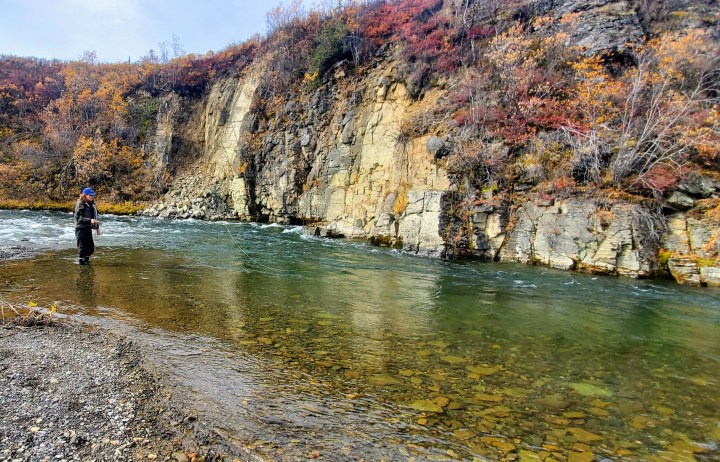
Photo: Me, fly-fishing for Arctic grayling in Interior Alaska. Grayling are highly sensitive fish and are often referred to as an indicator species because they require pristine, cold water to thrive. Credit: Frank Meyer.

