“O triple sob—turned forty
at midnight—body at dawn
booze-soddened but hopeful,
knowing that the only thing
to remember is dreams.”
– Jim Harrison, A Redolence for Nims (excerpt)
This poem has been pinned to the wall behind my computer since my early twenties, when I first discovered Jim Harrison.
Back then, I was both a vegetarian and lover of anything published prior to 1929. I once told someone, “Lady Chatterley’s Lover is where I draw the line.” My library was still mostly stocked with Romantic and Victorian books, and reading them often felt like an escape into a rarefied world far from the ugly landscape of real life. As I read Lady Chatterley’s Lover, I was conflicted. It seemed the c-word was on nearly every page, but the language was still so beautiful, so in my twenty-something arrogance, I allowed D.H. Lawrence to remain in my canon of acceptable literature.
Later that same year, while I still ate only vegetables and soybeans, I discovered both Jim Harrison and hunting. Both discoveries were seemingly by chance and via a man.
He was an outdoorsman from Michigan, one of those transplants to Alaska who quickly make Alaskan outdoorsmen look bad. Nearly every weekend, he ventured deep into the small wildernesses we Alaskans become inured to and ignore. Much later, his brother would become famous as a great author and advocate for hunting and conservation, and the star of the MeatEater series.
The morning after I met him, he asked me if I wanted to go Dall sheep hunting with him in the mountains behind Anchorage for the weekend. Before we left, we strolled into a Subway, and without seeing the irony, I ordered my usual vegetarian sandwich to take with me. That weekend, as he peered down the scope on his rifle, I secretly rooted for the sheep in his crosshairs. The animal moved out of sight, and he did not get a sheep that weekend. Before we came out of the mountains, I told him I had once been diagnosed with bipolar disorder, but I no longer had it.
The next week, I picked him up after work. When he climbed into my Isuzu pickup, he immediately noticed both the rattling lug nuts, which never bothered me and would not until months later when one of my wheels came off, and the seventeen books on the passenger seat. He counted them out loud as he moved them. I was in my junior year of college, and three of the books were required texts. The remaining fourteen I had checked out from the library because “I just wanted to know more.” This he apparently found fascinating.
As we grew more serious, he took me to Michigan to meet his family, and there, he and his brothers let me tag along on short hunts in nearby farmland. On our first hunt, they asked me to jump on a fallen tree. Several rabbits ran in all directions, and as the air rang out with shots, I squealed in panic. They laughed; I was an Alaskan girl, so shouldn’t I be inherently tough? Later, I followed them as they chased grouse through a dark forest full of tall, emerald-colored trees, the barrels of their shotguns raised into the air. Every time I heard a shot, my heart thumped as if my body were as hollow-boned and light as the birds.
I had been raised by intellectuals who kept a neat and well-landscaped yard in suburban Anchorage, and who never thought that blood—or worse—the death of any creature, should be part of a Sunday hiking trip into the capital-N Nature I was taught to love as a child. We revered the wilderness outside of Anchorage like Wordsworth loved the Lake District; it was a place to wander, where I composed my own abstract, atmospheric lines, and my feet were never tainted by the soil.
Over the next two years, my “vegetarian experiment” faded into the background of my history as my new boyfriend taught me how to hunt. He took me caribou hunting in the High Arctic, up the Placer and Portage Rivers for ducks and geese, into Turnagain Pass for ptarmigan, and onto Kodiak Island for deer where I learned to stand guard against brown bears with a borrowed 30.06 rifle.
The more I ventured into the wilderness with him, the more my worldview shifted.
One day, after an early morning spent duck hunting and then struggling to pluck the feathers from a lifeless duck in the afternoon, I found a book by Jim Harrison in this man’s bookcase. As I sat cross-legged on the floor, I ran my finger along the pages, finding lines that would live with me forever: On a cold day/bear, coyote, cranes./On a rainy night/a wolf with yellow eyes.
Another element in my cosmos shifted that afternoon. His words were bloody, cruel, and yet still beautiful. He did the unthinkable and cursed in his poetry, and his voice was virile and often sexual. He painted landscapes full of prowling coyotes and thrusting hips inside hotel rooms, and he wrote about depression and desire. Harrison’s nature was one where animals—and humans—killed for food. This seedy underside of life was what my vegetarian, Victorian self had done its best to ignore.
I first hung A Redolence for Nims behind my computer towards the end of that relationship, at twenty-three, when I increasingly struggled with my sanity, learning slowly that perhaps reading seventeen books at once might indicate a problem, an imbalance that tipped in a direction not conducive to healthy relationships or daily life.
Fascinating? Yes. Gifted? Perhaps. Functional or sustainable? No.
I was far, far south of forty years old during most of my readings of this poem. As my sanity unraveled, I often thought that I would not make it to forty, or even thirty. As I read this poem on my thirtieth birthday, I still struggled with insanity. Even though I had learned to limit myself to prevent mania’s return—and to function despite it—the threat of madness still seemed to linger around the edges of my world. And there was always an assumption beneath each of my thoughts of the future: There is no way you will make it to forty. And even if I did, it felt so far away, I could not imagine its arrival.
Until it did.
I do not remember how I spent my fortieth birthday, whether I had chocolate or vanilla cake, or what gifts I received, but I do remember one thing: the night before its arrival, I set an alarm on my phone for the next morning that said, “Redolence!” At seven a.m., my iPhone shouted from the bedstand, in its distinctly computerized voice: “Redolence!” My husband, used to my strange predilections toward interesting words, just smiled and said, “Happy birthday, darlin’.”
I drank my coffee alone that morning, and read A Redolence for Nims.
This is a prayer, plaint, wish,
howl of void beneath breastbone.
After seventeen years of waiting, I finally had turned “forty at midnight.”
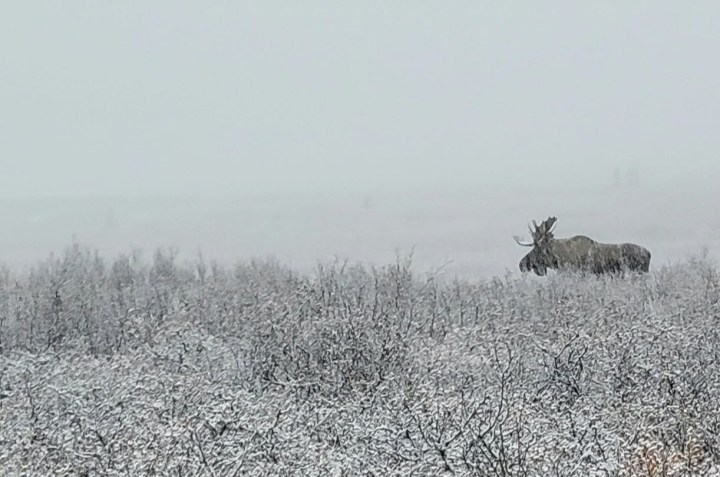
Next year, I will be fifty. Over the decades, I have shot caribou and moose to feed my family. I have protected my family from grizzly bears and pressed my hands into the warm carcasses of thousand-pound moose. I have peeled their hides, held steaming hearts in my palms, and felt the breadth and heat of the entire spectrum of life.
I survived my many historic madnesses, and in my forties, I even began writing publicly about them, not sparing the gruesome details of what can be an extremely ugly illness. During the last three years, as I wrote my memoir, I often felt myself escaping into rarefied language—the words and rules of literature before 1929—but then I remember, and I reach into the meat of it.
Excerpts from “A Redolence for Nims” and “North” by Jim Harrison, from Jim Harrison: Complete Poems (Copper Canyon Press, 2021).


